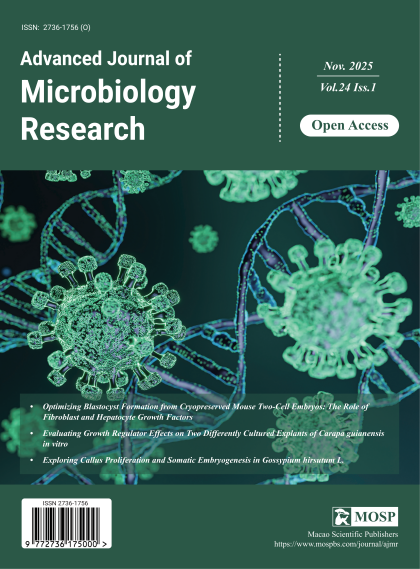
Advanced Journal of Microbiology Research

AJMR
A peer-reviewed, open-access journal covering all aspects of microbiology and related disciplines. It was established in 2002 with a mission to publish rigorously peer-reviewed research across the entire spectrum of microbiology. [Aims & Scope] More
Published by
Macao Scientific Publishers (MOSP)
Editor-in-Chief
Prof. Panagiota Florou-Paneri
Copyright
Open access under CC BY 4.0
ISSN
Online-ISSN: 2736-1756

2005 Vol.4 Iss.1 (47 articles)

Research Article

Stability of yam starch gels during processing

Abstract: To evaluate their aptitude to be used as functional ingredients, twenty one varieties of yam starches of Côte d’Ivoire were submitted to different technological stress such as high temperature treatment, long term freezing and refrigeration, high speed shearing and acidic treatment, in comparison with commercial modified starches. The gel of “kangba” starch (D. Cayenensis-rotundata) is the most stable during thermal processing. The cultivar “Daminangba” ( D. alata) which present the clearest gel (63 % of clarity) i…
AJMR 2005, 4(1), 1-6;
Full Text Download PDF Views: 989  |  Downloads: 789
Research Article

Retention of -carotene in frozen carrots under varying conditions of temperature and time of storage

Abstract: Carrots were blanched and stored in a freezer to study the retention of - carotene. Retention was found to be better in 3 min blanched samples than in 5 min ones. There was an increase in -carotene content in carrots after 5 days at all storage temperatures: 0, –8, –14, and –18oC. Decrease was found to be insignificant compared to the initial value even after 80 days of storage time at –18oC and for 3 min blanch time.[...]
AJMR 2005, 4(1), 1-6;
Full Text Download PDF Views: 1042  |  Downloads: 777
Research Article

Export papaya post -harvest protection by fungicides and the problems of the maximal limit of residues

Abstract: The post-harvest maturity of papaya fruits is influenced by several environmental factors including temperature, light and ventilation of the surrounding wall. The maturity, presence and attacks or rots, and the accumulation of fungicide residues in the papaya was evaluated on papaya fruits treated with different fungicide. Thiabendazole-treated fruits did not rot 21 days after treatment and this fungicide was the most satisfactory with detected residues lower than the European Union’s 2000/48/EC guideline.[...]
AJMR 2005, 4(1), 1-6;
Full Text Download PDF Views: 972  |  Downloads: 723
Research Article

Histopathology of the gill and liver tissues of the African catfish Clarias gariepinus exposed to lead

Abstract: An investigation on the effect of the heavy metal, lead (Pb) on the gill and liver of the African catfish Clarias gariepinus was carried out in the laboratory. One hundred and sixty (160) fingerlings of the fish were exposed to continuous exposure to sub-lethal concentrations (0.006 mg/l and 0.008 mg/l) of lead for a period of three weeks. The liver and gill of fish were removed every 9 days for histological examination. The results showed that the degree of distortion of the gills and liver was proportional to the…
AJMR 2005, 4(1), 1-6;
Full Text Download PDF Views: 1062  |  Downloads: 850
Research Article

Microbial control of caged population of Zonocerus variegatus using Beauveria bassiana and Metarhizium sp.

Abstract: Microbial control of caged populations of Zonocerus variegatus was carried out using indigenous fungal entomopathogens isolated from the grasshopper’s cadaver. Bioassay response indicated a dose-dependent mortality coupled with drastic reduction in food consumption among spores infected grasshoppers. Lethal time (LT50) of 4.6 days for 103 spores/ml and 3.8 days for 107 spores/ml of oil formulation of Beauveria bassiana were observed. While Metarhizium sp recorded LT 50 of 9.0 days and 2.8 days for 103 and 107 spore…
AJMR 2005, 4(1), 1-6;
Full Text Download PDF Views: 988  |  Downloads: 794
Review

Antioxidant potential of African medicinal plants

Abstract: Cellular damage or oxidative injury arising from free radicals or reactive oxygen species (ROS) now appears the fundamental mechanism underlying a number of human neurodegenerative disorders, diabetes, inflammation, viral infections, autoimmune pathologies and digestive system disorders. Free radical are generated through normal metabolism of drugs, environmental chemicals and other xenobiotics as well as endogenous chemicals, especially stress hormones (adrenalin and noradrenalin). Accumulated evidence suggests th…
AJMR 2005, 4(1), 1-6;
Full Text Download PDF Views: 990  |  Downloads: 798
Review

Application of biotechnology for the improvement of Nigerian indigenous leaf vegetables

Abstract: Nigeria is endowed with many indigenous leaf vegetables (ILVs) species, which spread across the estimated cultivable land area of 71.2 million hectares. These ILVs provide food, income, employment and herbal medicine to the population. Uncollected and uncharacterized germplasm, pests, diseases, anti-nutritional factors, recalcitrant seed, seed dormancy and perishable produce militate against the realization of potentials of the ILVs. This paper discusses biotechnological applications such as meristem culture, in vi…
AJMR 2005, 4(1), 1-6;
Full Text Download PDF Views: 982  |  Downloads: 771
Review

Crop protection strategies for major diseases of cocoa, coffee and cashew in Nigeria

Abstract: A great percentage of people in the developing countries are engaged in agriculture, but the yields of their produce are low due to diseases that plague their crops. In Nigeria, crop protection measures that are cheap, simple, cost-effective and sustainable are desirable to combat Phytophthora pod rot (black pod) and cocoa swollen shoot virus diseases of cocoa, coffee leaf rust and coffee berry diseases, inflorescence blight disease of cashew in order to make farming profitable and sustainable. Disease control stra…
AJMR 2005, 4(1), 1-6;
Full Text Download PDF Views: 989  |  Downloads: 856
Research Article

Isolation and characterization of micro satellites in Bambusa arundinacea and cross species amplification in other bamboos

Abstract: Isolation and characterization of microsatellites was analyzed in Bambusa arundinacea and cross species amplification in other bamboos. Six microsatellites, three polymorphic and three monomorphic, were characterized in a bamboo species, Bambusa aruninacea belonging to the family Poaceae. The numbers of alleles per locus ranges form 2 to 6. Allelic diversity ranges from 0.128 to 0.789. Polymorphic Information Content (PIC) values for two loci were > 0.3, as an indicator of polymorphic allele. Cross species amplific…
AJMR 2005, 4(1), 1-6;
Full Text Download PDF Views: 1009  |  Downloads: 763
Short Communication

Isolation and characterization of a Coffea canephora ERF-like cDNA

Abstract: ERFs (Ethylene-Responsive Element Binding Factors) are members of a transcription factors family unique to plants. They contain a well-conserved segment, which interacts specifically with sequences containing AGCCGCC motifs (GCC box) located in the promoter region of genes activated during biotic or environmental stress in plants. A cDNA corresponding to an ERF gene has been isolated from a Coffea canephora fruit cDNA library. The cDNA was 1,317 nucleotides long and has an open reading frame of 987 bp. The predicte…
AJMR 2005, 4(1), 1-6;
Full Text Download PDF Views: 954  |  Downloads: 790
Research Article

Characteristics of fermentation yeast isolated from traditional Ethiopian honey wine, ogol

Abstract: Indigenous honey wine, known locally as ogol, was collected in a village of the Majangir ethnic group in Southwest Ethiopia, and the procedure for ogol fermentation was investigated. A fermentation yeast was first isolated from ogol and identified as being a strain of the genus Saccharomyces cerevisiae. Honey wine made with S. cerevisiae ET99 contains 16.5% (v/v) ethanol; the acidity and pH were 6.0 and 3.8, respectively. Volatile ester and higher alcohol were detected by gas chromatography. A relatively higher amo…
AJMR 2005, 4(1), 1-6;
Full Text Download PDF Views: 996  |  Downloads: 804
Research Article

Production of bioemulsifier by an unusual isolate of salmon/red melanin containing Rhodotorula glutinis

Abstract: An unusual isolate of Rhodotorula glutinis was obtained. The yeast produces a spore and a crystalliferous protein per cell. Sodium dodecyl sulfate polyacrylamide gel electrophoresis revealed that the parasporal crystals contained polypeptides with a molecular mass of approximately 55, 47, 40, 36 32.5, 30 and 25 kD. The yeast also produces a salmon/red pigment at late stage of exponential growth, which has physical and chemical properties that are consistent with it being a form of melanin. The organism has been use…
AJMR 2005, 4(1), 1-6;
Full Text Download PDF Views: 982  |  Downloads: 789
Research Article

Utilization of petroleum hydrocarbons by Pseudomonas sp. and transformed Escherichia coli

Abstract: Our previous studies showed that the biodegradation of petroleum oil by a pseudomonas isolated from a petroleum -contaminated soil was instable. In this work, it is shown that when the isolates are immobilized on Perlite, they are more stable for oil degradation. Although the isolate did not have any chemotaxis to octadecane, dodecane and octane but utilize octadecane and dodecane better than octane and it did not utilized hexane, benzene, kerosene, pentane, heptane or thiophenol. The generation time for degradatio…
AJMR 2005, 4(1), 1-6;
Full Text Download PDF Views: 1140  |  Downloads: 759
Research Article

Urinary schistosomiasis in a rural community in Edo state, Nigeria: Eosinophiluria as a diagnostic marker

Abstract: The prevalence of urinary schistosomiasis in Ikpeshi, a rural community of Edo State, Nigeria showed that 195(65%) out of 300 volunteers harboured Schistosoma haematobium ova in their urine. Eosinophiluria was markedly significant > 5 eosinophilic leucocyturia/hpf and reported among 250 (83.3%) inhabitants. Of these, ova were absent in 55 (22.0%) of urine samples but had other associated urinary symptoms namely; proteinuria or haematuria or both. Eosinophiluria among the inhabitants with light infections as describ…
AJMR 2005, 4(1), 1-6;
Full Text Download PDF Views: 966  |  Downloads: 755
Review

Implicating roles of animal reservoir hosts in the resurgence of Gambian trypanosomosis (Sleeping Sickness)

Abstract: Gambian trypanosomosis (Sleeping Sickness) is a complex and debilitating disease of man. For many years the disease has been ravaging in several parts of sub-saharan Africa despite decades of therapeutic control. Although animal reservoir hosts are believed to be associated with the disease, not much evidences have been established to prove the true existence of animal reservoir hosts for Trypanosoma brucei gambiense and the zoonotic nature of Gambian Sleeping Sickness. This paper reviews recent evidences based on…
AJMR 2005, 4(1), 1-6;
Full Text Download PDF Views: 986  |  Downloads: 740
    1  2  3  4    
Submit Your Manuscript Now
0.628743s